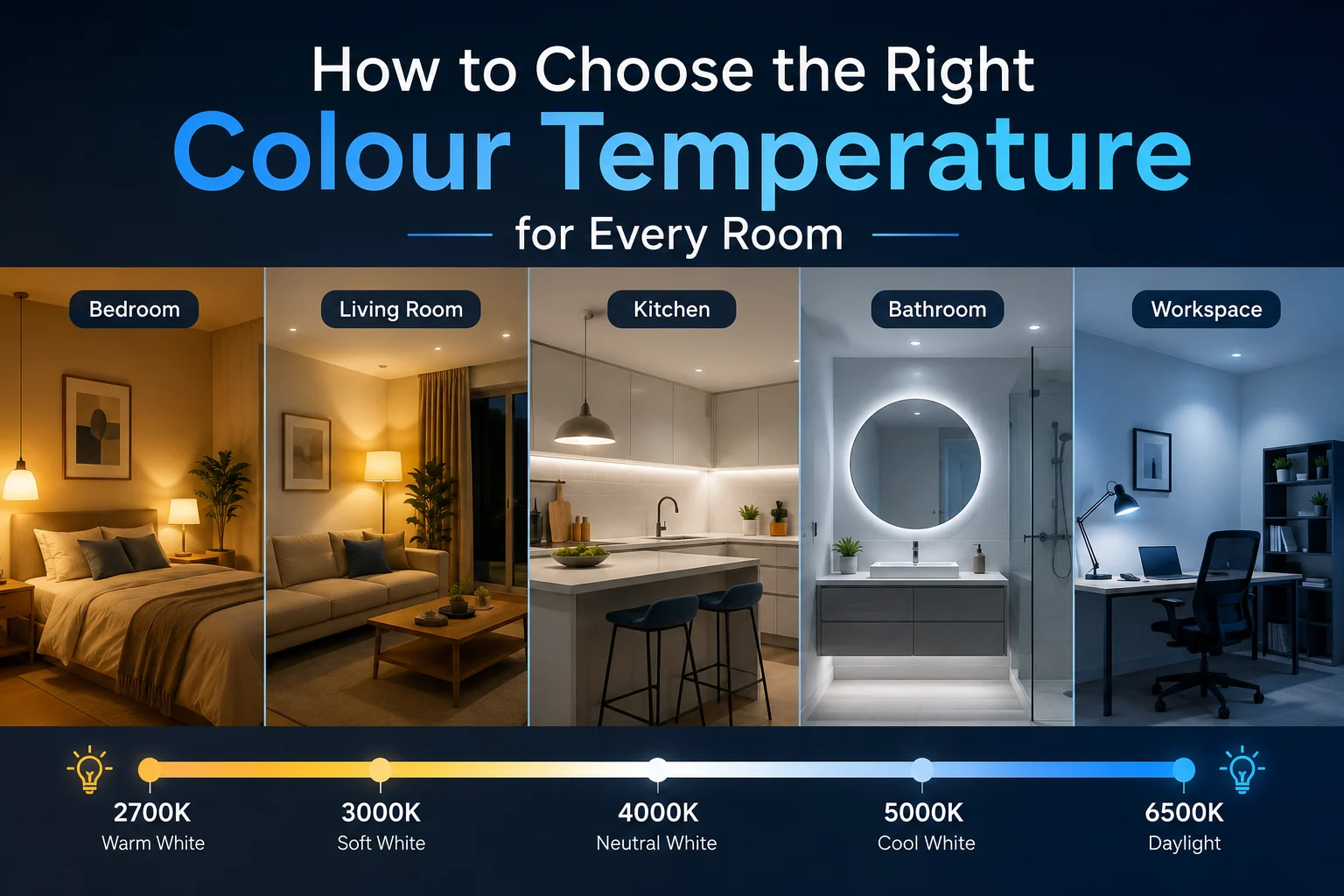
Walk down the lighting aisle and grab two identical glass orbs. They pull the exact same wattage. Yet, plug one into a desk lamp and your den feels like a hidden tavern. Try the other, and suddenly you feel like a patient in a dental chair. Most buyers miss the secret ingredient entirely. We measure a bulb’s color appearance using Kelvin (K). The logic feels completely backward. A lower Kelvin rating creates a yellow glow, while higher numbers turn blue. Nailing the right Colour Temperature for Every Room takes more than a lucky guess. With the right architectural lighting, you can create the perfect atmosphere and functionality for each space. We are tackling the house room by room.
What Does Colour Temperature Actually Mean?
Kelvin, Not Heat
This number simply tells your brain what hue the light is. It has nothing to do with burning your fingers on the glass. A low number looks downright amber. Climb higher on the scale, and things turn stark white.
The Kelvin Ladder
1800K to 2200K: Candlelight 2700K to 3000K: Warm White 3500K to 4000K: Neutral 5000K to 6500K: Daylight
Lower K equals a warmer look. Higher K equals a colder look. This scale decodes light and temperature quickly. It points out a decent warm light colour without fuss. Figuring out light colour temperature fixes weird interior design mistakes overnight.
Warm, Neutral or Cool?
Warm White
Falling between 2700K and 3000K. Built for sleeping spaces, dens, and eating corners. The soft yellow tone helps people unwind.
Neutral White
Sitting at 3500K to 4000K. Perfect for food prep zones and bathrooms. It serves as a great compromise when judging natural white vs cool white.
Cool White / Daylight
Hitting 4000K to 6500K. These tones feel highly clinical indoors. Reserve them strictly for garages or intense utility tasks. This harsh divide exposes the true difference between warm white and cool white, laying out the warm white vs cool white light debate clearly.
Colour Temperature for Every Room
Bedroom (2700K to 3000K)
Your sleeping quarters need a gentle hand. A soft, warm light for bedroom setup signals your brain to power down. Bedside lamps can dip lower into a 2200K candle vibe. Do not leave the space too dark to get dressed, though. Blindly grabbing a yellow-branded warm light bulb off a shelf is risky. You need the exact numbers to master the perfect Colour Temperature for Every Room.
Living Room (2700K to 3000K)
Cozy yellow lighting gets conversations flowing. Pair a ceiling fixture with a couple of floor lamps. That tint plays nicely against wood floors and brass hardware. Look at your wall paint to discover the best light colour for home relaxation.
Dining Area (2700K to 3000K)
Nobody wants dinner to look grey. A deep, warm light colour creates an intimate restaurant feel. Suspending a fixture directly over the table works wonders.
Kitchen (3000K to 4000K)
A soft ceiling glow feels nice, but chopping onions takes real visibility. A crisp neutral tone handles food prep better. You might put a different Kelvin rating under your cabinets than you do on the ceiling. Deciding between warm white vs natural white, and studying neutral white vs warm white, saves the entire room layout.
Bathroom & Dressing Area (3500K to 4000K)
Shaving requires absolute clarity. Your vanity mirror should never cast heavy shadows. A neutral rating offers a practical middle ground. Weighing cool white vs warm light is critical right at the sink.
Home Office & Study (3500K to 4500K)
Paying taxes demands focus. Crisp neutral lighting suits daytime desk work nicely. Check screen glare before committing. The whole warm light vs white light puzzle dictates your productivity.
Hallways, Staircases & Transitional Areas (3000K to 3500K)
Hallways connect totally different environments. A middle ground prevents a harsh shock when walking from the bright kitchen to the cozy den.
Warm White vs Natural White vs Cool White
2200K to 2700K creates amber. 2700K to 3000K creates warm white. 3500K to 4000K creates neutral white. 4000K to 5000K creates cool white. 5000K to 6500K creates harsh daylight.
Box labels confuse consumers endlessly. Ignore the marketing text and check the actual digits. This settles the difference between warm white and cool white fast. It helps you choose between warm white vs natural white and clearly identifies natural white vs cool white.
Is Warmer or Cooler Light Better for Your Eyes?
People always wonder if warm white or cool white is better for eyes, and there is no single answer. Comfort relies on your activity and the time of day. Dimly lit reading causes strain. Bright clinical sources feel terrible during a quiet movie night. So, is warm white or cool white better for the eyes, exactly? It depends entirely on the moment.
Colour Temperature Is Only Half the Decision
Brightness vs Colour
Kelvin controls the look. Lumens control the brightness. CRI handles color accuracy. A 3000K choice does not mean the space is automatically bright enough.
Don’t Ignore Daylight
North and south windows capture completely different sunshine. Wall colors and flooring types alter how warm a room actually feels.
Layer the Light, Don’t Force One Temperature
A smart layout mixes ambient, task, and accent fixtures. A sleeping space might use a 2700K ceiling base, a 2700K reading lamp, and a 2200K decorative piece. Layering fixes the warm light vs white light puzzle and establishes your exact light colour temperature.
How SASCO Makes Lighting More Than a Bulb Choice
SASCO Smart Homes goes far beyond twisting in a new piece of glass. They link your fixtures to a massive network. They handle Home Automation, Audio-Visual Solutions, and Smart HVAC Systems. Their technology includes single-touch control, voice commands, custom scheduling, remote access, and biometric security. For overhead systems, they manage ambient and task planning alongside technical Dialux mapping. This calculates precise distribution, eliminates nasty glare, manages shadows, and provides 3D visualisation. They are designed around your lifestyle, tying light and temperature together perfectly. This sets up the ultimate Colour Temperature for Every Room.
A Simple Colour-Temperature Decision Flow
Will you sleep or relax? Use 2200K to 3000K. Will you cook or read? Use 3000K to 4500K. Will you do intense visual tasks? Try 4000K to 5000K. Does the area get huge amounts of sunlight? Consider a neutral artificial setup. If not, go warmer. This simple logic isolates the ideal Colour Temperature for Every Room.
Common Colour-Temperature Mistakes
- Buying strictly by wattage.
- Thinking brighter always equals better.
- Putting 6500K everywhere.
- Slapping one exact tone across the whole property.
- Ignoring sunlight direction.
- Forgetting about screen glare.
- Throwing random tones together in connected halls.
Skipping these errors helps navigate neutral white vs warm white and settles the cool white vs warm light argument.
The Right Light Depends on the Right Moment
A smart home adjusts constantly. Morning takes a neutral tone. Afternoon rides in natural sunshine. Evening fades into a warm yellow. Time-based scenes link up perfectly with SASCO’s home automation. Your favorite warm light bulb setting can be triggered strictly at sunset, giving you that rich warm light colour exactly when needed.
Conclusion
The correct choice matches whatever the space asks of you. Warm tones relax the brain. Neutral options handle daily chores. Cooler numbers belong in highly active zones. Layering beats a uniform approach every single time. Deciphering the difference between warm white and cool white, or comparing warm white vs natural white, becomes incredibly easy. Automation ends the natural white vs cool white and warm white vs cool white light debates. Knowing your way around neutral white vs warm white and cool white vs warm light is vital. Securing the best light colour for home design means mastering light and temperature. Achieving the right warm light vs white light balance gives you the ideal Colour Temperature for Every Room.
Acronyms Used
| Acronym | Meaning | Why it matters |
| K | Kelvin | Measures colour temperature |
| LED | Light Emitting Diode | Common energy-efficient lighting technology |
| CRI | Colour Rendering Index | Indicates colour-rendering accuracy |
| HVAC | Heating, Ventilation and Air Conditioning | Controls indoor climate |
| AV | Audio-Visual | Covers integrated sound and visual systems |
| 3D | Three-Dimensional | Used for lighting visualisation |
FAQs
1. What is the best colour temperature for a bedroom?
For most bedrooms, 2700K–3000K warm light creates a soft, relaxing atmosphere.
2. Is warm white or cool white better for the eyes?
For relaxing at night, warm white is usually more comfortable, while cooler light can suit focused daytime tasks.
3. What is the difference between warm white and cool white?
Warm white looks yellowish and cosy, while cool white appears crisper and more bluish.
4. Is natural white or cool white better for a kitchen?
Natural or neutral white around 3500K–4000K usually works well for clear, comfortable kitchen tasks.
5. Should every room use the same light colour temperature?
Not necessarily. Colour Temperature for Every Room should match the room’s purpose, activity, daylight, and desired mood.