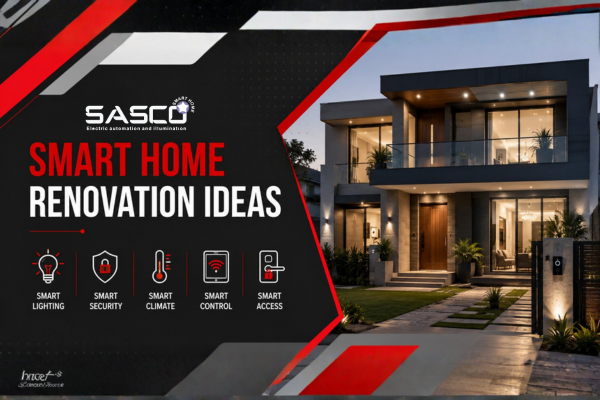
Renovation is usually the moment people do what they couldn’t do when they first moved in. Fresh layouts, better finishes, more light. What often gets left out of the plan — and then retrofitted awkwardly later at higher cost — is smart home technology. A smart home renovation planned from the start gives you connected home devices, automated home systems, and smart living solutions built into the structure rather than layered on top of it afterward.
Planning a home automation renovation isn’t complicated. It’s mostly a matter of knowing which systems to prioritise, how they work together, and what decisions need to happen before walls are closed. For homeowners in Delhi NCR, SASCO Smart Homes designs and installs these systems as part of complete renovation and new-build projects — handling everything from architecture-stage planning through to final commissioning.
This guide covers what a smart home renovation actually involves, which upgrades make the biggest difference, and what to avoid.
What Is a Smart Home Renovation?
A smart home renovation integrates automation and connected technology into an existing home — or a home being rebuilt — so that lighting, climate, security, and entertainment systems can be controlled from a single point.
The difference between a smart renovation and just buying smart devices is integration. Individual smart bulbs or a standalone smart lock don’t constitute a smart home. A home automation system where lighting responds to occupancy, climate adjusts to time-of-day schedules, and security operates from one app — that’s what the renovation is actually building toward.
Essential Smart Home Features to Consider During Renovation
The renovation phase is the most cost-effective time to add smart home infrastructure. Once walls are sealed and finishes are in, wiring and cabling become expensive disruptions. Here’s what to plan in while the structure is open.
Wiring for automation
Even if you’re starting with a wireless system, running conduit and network cabling during renovation gives you flexibility to upgrade without tearing walls open later. A structured cabling run costs very little at the renovation stage compared to retrofitting.
Smart panel or control hub
A central point where the home automation system connects and can be configured. This is the brain of the installation, whether it’s a KNX panel for a wired system or a hub for a wireless one.
Provision for smart lighting
Dimmer-compatible wiring, correct switch positioning, and neutral wires in switch boxes (often missing in older Indian construction). These decisions made at renovation stage cost almost nothing. Made afterward, they cost significant rework.
HVAC control points
Positioning thermostats and HVAC control modules for easy system access during installation.
Smart Lighting and Climate Control for Better Living
Smart lighting solutions are the most immediately noticeable upgrade in any home. Scenes replace individual switches — “Morning,” “Evening,” “Away” — with each scene adjusting every light in the space simultaneously. Motion sensors handle routine switching automatically. Colour temperature shifts through the day in ways that genuinely affect how a room feels by evening.
Paired with a smart thermostat, climate control becomes automatic too. The system pre-cools rooms before usual arrival times, adjusts zone temperatures based on which areas are occupied, and pauses cooling when windows are open. In India’s climate, where air conditioning runs six to eight months a year, the energy savings from smart climate control are measurable within the first year.
This combination — smart lighting and automated climate — also makes a home energy-efficient in ways that passive upgrades alone can’t replicate. It’s a core part of any serious home automation renovation.
Smart Security Upgrades for Modern Homes
A smart security system integrates cameras, video doorbells, smart locks, motion sensors, and alarms into one platform. For a homeowner mid-renovation, this is the right time to wire camera positions, plan door lock rough-ins, and route cabling for sensor placement.
What this setup delivers is visibility. Real-time alerts when motion is detected. Door access logs showing who entered and when. Remote camera access from anywhere. Temporary access codes for housekeeping or delivery that expire automatically.
This isn’t surveillance for its own sake — it’s the ability to know what’s happening at your home when you’re not there, without depending on a building security team or physical presence. For families and frequent travellers, a voice-controlled home with integrated security is a meaningful quality-of-life upgrade, not a luxury.
Common Mistakes to Avoid During a Home Automation Renovation
Planning automation after finishes are decided.
The most expensive version of smart home installation happens when you try to add it after construction is complete. Conduit placement, switch box neutral wires, and ceiling provisions for sensors all need to be decided before plastering, not after.
Buying devices before deciding the system.
Different smart home devices operate on different protocols — Zigbee, Z-Wave, KNX, Wi-Fi, Bluetooth. Mixing incompatible products creates an integration headache that no app can fully resolve. Decide on the system architecture first, then select devices that work within it.
Underestimating the network.
Wireless smart home systems depend entirely on network quality. A renovation that doesn’t include an access point plan — coverage across every room and floor — will result in dead zones that affect device performance. Wi-Fi infrastructure is part of the smart home installation, not an afterthought.
Choosing consumer products for a permanent home.
Off-the-shelf smart devices are fine for renting or temporary setups. For a home you’re renovating to live in for years, professional-grade systems with proper commissioning and after-sales support make more sense. Consumer devices don’t come with someone to call when they stop working.
How to Plan a Successful Smart Home Renovation?
Start by listing the outcomes you want, not the products. “I want lights that turn off when I leave a room” is more useful than “I want Philips Hue.” Working from outcomes to products with an experienced integrator avoids the mismatch of buying the wrong hardware for the right goal.
Involve the automation consultant at the same stage you involve your architect or interior designer. The three need to coordinate — switch positions, cable routes, ceiling provisions, and panel locations all affect the interior design and structural drawings.
Budget in phases if the full build isn’t affordable immediately. A renovation that installs wiring infrastructure in phase one can add the smart home devices and control systems in phase two without reopening walls. The key is getting the infrastructure right while it’s accessible.
SASCO Smart Homes works with homeowners from the planning stage through to installation and commissioning, covering smart home upgrade ideas and system design across Delhi NCR. For a consultation on your renovation project, visit sascosmarthome.com or reach out at projects@sascosmarthome.com.
Conclusion
A smart home renovation done well disappears into the background. The automation handles the routine, the security handles the monitoring, and the lighting and climate adjust without manual input. What remains is a home that’s more comfortable, more efficient, and easier to manage than the one that existed before renovation.
The decisions that determine whether that outcome is achieved happen early — during planning, before walls are closed. Start there.
Smart lighting, automated climate control, smart security systems, and integrated home automation are popular upgrades.
Installing automation during renovation is easier and more cost-effective since wiring and infrastructure can be planned in advance.
Yes, smart lighting, climate control, and automated schedules can improve energy efficiency and reduce electricity consumption.
Many smart home systems can integrate with compatible appliances, allowing centralized control and automation.
Focus on your needs, budget, network infrastructure, and choose a system that can be expanded in the future.