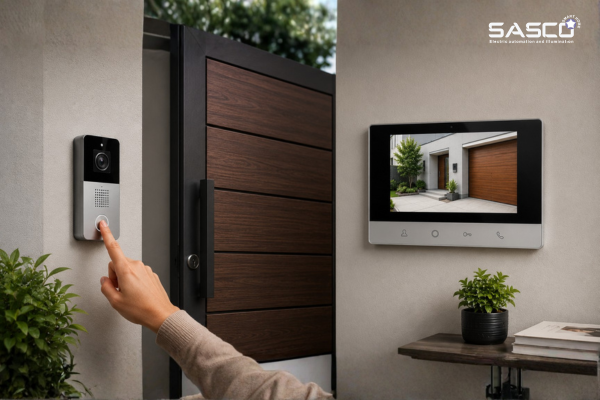
Most people don’t think about entrance security until something happens near their door — an unfamiliar visitor, a missed delivery that may not have been a delivery at all, or a moment where they wished they could see who was outside before opening. Video door phones address exactly this gap: they give you visual and audio access to your entrance before any physical interaction happens.
A video door phone system is now a core part of smart home security setups across Indian residential and commercial buildings. The technology has improved considerably — Wi-Fi video door phone options, HD security camera quality, mobile app control — and the price points have come down enough that the decision is less about whether to install one and more about which type suits your home.
SASCO Smart Homes installs video door phone systems as part of complete home automation and smart home security setups across Delhi NCR, handling product selection, wiring, integration with existing systems, and commissioning.
What Is a Video Door Phone System?
A video door phone system is a two-way communication device installed at your entrance. A camera unit sits outside the door — capturing video of whoever is at the threshold. A monitor or app inside the home displays that feed and allows the resident to speak to the visitor, verify their identity, and control door access without being physically present at the entrance.
Modern systems extend this further. The outdoor unit can trigger motion detection alerts when anyone approaches, send a real-time notification to your phone, and log visitor activity with timestamps. Some systems connect directly to smart door locks, making video door phones part of a complete home access control system.
Types of Video Door Phones
Wired Video Door Phone
The outdoor camera unit connects to the indoor monitor via a dedicated cable. Reliable, stable performance, and doesn’t depend on Wi-Fi. The standard choice for villas and houses during construction, where running cables is straightforward.
Wireless Video Door Phone
Connects to your home network over Wi-Fi. No dedicated cable required, which makes it practical for apartments and retrofit installations where running new wiring would mean opening walls. Performance depends on network signal quality at the entrance point.
IP-Based Video Intercom System
Runs over your existing IP network infrastructure. Scalable and flexible — one outdoor unit can connect to multiple indoor monitors or directly to mobile phones without a dedicated monitor. Common in multi-unit residential buildings with a visitor management system at the main gate.
Smart Video Doorbell
A compact format that mounts at the same position as a conventional doorbell. Usually Wi-Fi connected, with a companion app as the primary interface. Good for apartments with minimal entry points where the priority is mobile visibility rather than a wall-mounted monitor.
Benefits of Installing a Video Door Phone for Home
The primary benefit is knowing who’s at the door before opening it. That’s straightforward but genuinely useful — for families with children, for elderly residents managing their own security, for anyone in an apartment where the main entrance is shared.
Beyond that immediate purpose, a video door phone for home contributes to broader residential security system performance. Visitors know they’re being recorded. Behaviour at the entrance changes accordingly. Instances of door-to-door fraud and aggressive sales approaches — a real issue in Indian cities — are reduced when residents can screen from inside.
Remote door access through a mobile app is increasingly valued by frequent travellers and people who work late. You can see who’s at your door from a different state and communicate in real time. If the system is connected to a smart lock, you can grant access to a delivery or a trusted visitor without being home.
For gated communities and apartments, video door phones contribute to apartment security solutions at the unit level, complementing the building-wide security system rather than depending entirely on it.
Key Features to Look For
Camera Resolution
1080p or higher is now standard for anything installed in 2026. Lower resolution reduces useful detail in low-light conditions or when identifying visitors at a distance.
Night Vision
Infrared or colour night vision ensures the camera is useful after dark, which is when entrance security matters most.
Two-Way Audio
Clear, low-latency audio in both directions. This is the functional core of the system. Poor audio quality defeats the purpose.
Motion Detection Alerts
The camera should notify you when someone approaches, not just when they press the bell. This is the difference between reactive and proactive smart door monitoring.
Mobile App Integration
For wireless and IP systems, the companion app should be stable, receive push notifications reliably, and allow two-way communication without significant lag.
Storage
Cloud or local SD card storage for visitor logs. Useful for reviewing who came to the door during your absence.
Wide-Angle Lens
120–160 degree field of view captures the full entrance area, not just the face directly in front of the camera.
Wireless Video Door Phone vs Wired Systems
| Feature | Wireless Video Door Phone | Wired System |
| Installation | Minimal — no new cables required | Requires structural cable routing |
| Reliability | Depends heavily on Wi-Fi signal strength | Highly stable; entirely network-independent |
| Best For | Apartments, rental properties, and retrofits | Villas, bungalows, and new construction |
| Smart Integration | Easy, native connection with smart home apps | Requires a compatible central hub/gateway |
| Power Source | Battery-powered or Power over Ethernet (PoE) | Dedicated wired power supply |
| Range | Limited by your home’s Wi-Fi coverage | Determined strictly by the physical cable length |
| Cost | Generally lower upfront costs | Higher overall cost due to installation and labor |
For apartments in existing buildings or rental properties where modifications are restricted, a wireless video door phone is the practical choice. For villas and homes being built or renovated, a wired or IP-based system gives better long-term reliability and more integration options.
How to Choose the Right Video Door Phone
Start with Your Installation Constraints
Can you run a cable to the entrance? If yes, a wired or IP system is worth considering. If not, wireless is the answer and network coverage at the entrance becomes the key factor to check first.
Match the System to How You’ll Use It
If your priority is seeing and speaking to visitors from your monitor inside, a standard wired system with a dedicated screen works well. If you travel frequently and want mobile visibility, choose a system with a well-reviewed app and reliable push notifications.
Consider Integration
If you already have a smart home automation setup or are planning one, choose a video door phone that integrates with your existing system — lighting triggers, smart lock connectivity, or alarm integration. A door phone installation that sits as an isolated device is a missed opportunity when the rest of the home is automated.
Don’t Over-Specify for a Single Apartment Entrance
An IP-based entrance security system designed for a multi-building campus is unnecessary for a two-bedroom flat. Match the product category to the actual requirement.
For Delhi NCR homeowners planning a video door phone installation alongside broader home security or automation work, SASCO Smart Homes provides end-to-end service: consultation, product specification, wiring, integration, and commissioning. Visit sascosmarthome.com or reach out at projects@sascosmarthome.com.
Conclusion
A video door phone for home is one of the more practical security upgrades available — the technology is reliable, the use case is clear, and the installation is straightforward when done correctly. The choice between wired and wireless, between a monitor-based system and a fully mobile one, comes down to your installation context and how you actually use your home.
Get those two things right and the system works quietly in the background, doing exactly what you need it to do.
Yes. Wired video door phones can function without internet, though app-based remote access requires a network connection.
Yes. Wireless video door phones and smart video doorbells are popular choices for apartments due to their easy installation.
Yes, most modern video door phone systems allow remote viewing and communication through a mobile app.
Many systems support cloud or local storage, allowing you to save and review visitor footage and activity logs.
Most installations can be completed within a few hours, depending on the type of system and wiring requirements.