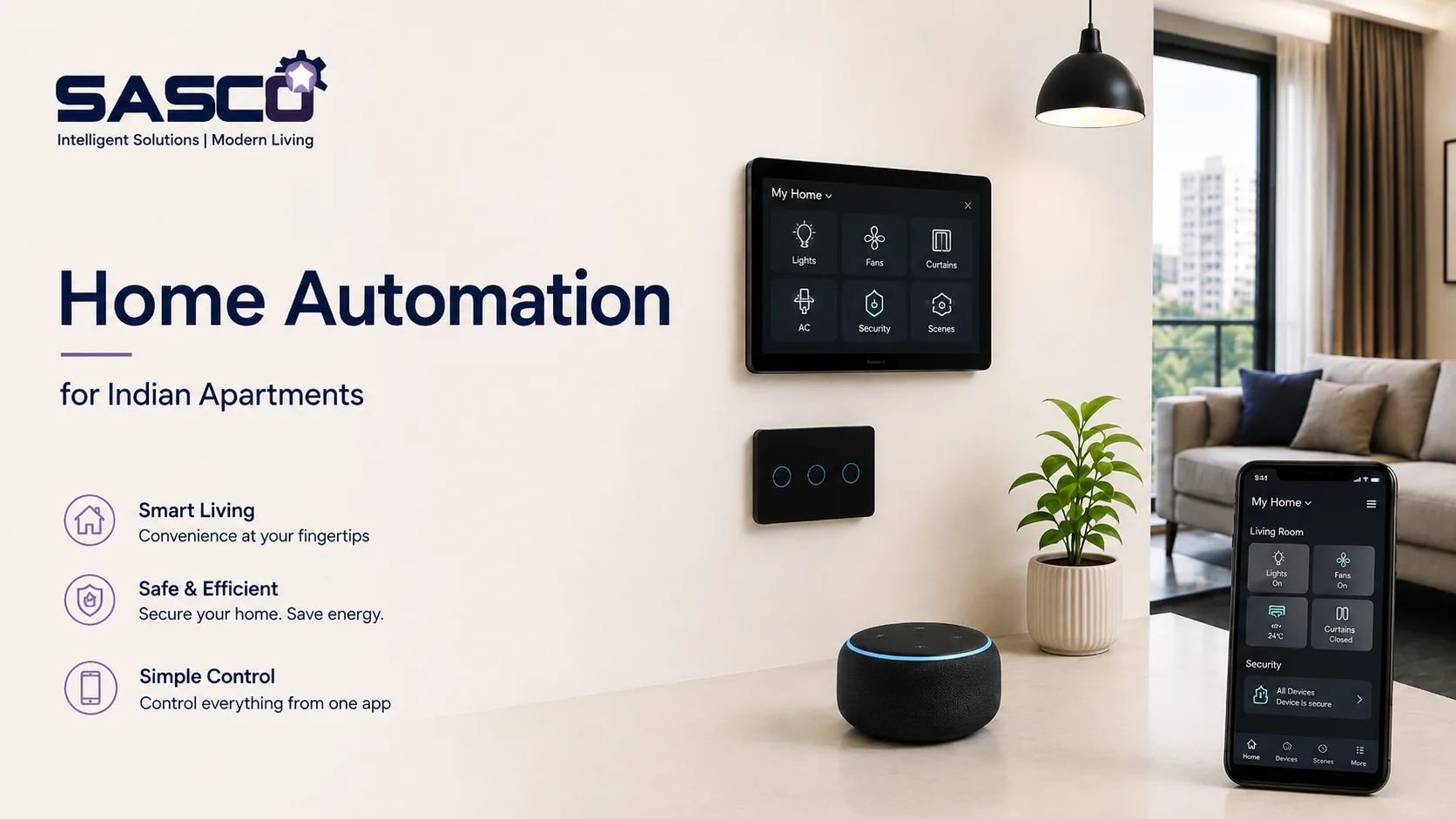
The most common question homeowners ask before automating their apartment isn’t about the technology — it’s about scale. How much does a 2BHK need? Will a 3BHK get expensive? Does a 1BHK even justify the investment? These questions come from a real uncertainty: home automation for 2BHK 3BHK setups sounds like it should cost twice or three times as much as a smaller home, but it doesn’t always work that way.
Apartment automation India has matured enough in 2026 that the cost-per-room for a 3BHK can actually be lower than for a 1BHK, once fixed costs like the central hub are amortised. Smart home automation today is also scalable — you can start with the living room and bedroom, and add rooms as budget allows, without rebuilding from scratch.
SASCO Smart Homes designs and installs home automation for apartments across Delhi NCR, handling everything from system design and wiring through to commissioning and after-installation support. This guide covers what makes sense for each apartment size, automation points per room, and how to plan without overspecifying.
What Is Home Automation and Why Does Home Size Matter?
Home automation connects the electrical systems in a home — lights, fans, curtains, AC, locks, cameras — to a centralised control interface. That interface is usually a mobile app, wall panel, or voice assistant.
Why does home size matter? Because the number of automation points — each controllable device or circuit — determines system cost and complexity. A 1BHK might have 15–20 automation points. A 3BHK can have 50 or more. The central hub, software, and integration work happen once regardless of size. The variable cost comes from how many switches, sensors, and devices are included.
Home Automation for 1BHK Homes: Essential Smart Features
A 1BHK automation setup works best when it focuses on the high-impact points rather than automating everything.
Entry and security — a video door phone, smart lock, and motion-activated porch light cover the security function that matters most in a single-person or couple household.
Living and sleeping space — smart switches for lights and fan, an AC controller, and a smart curtain if there’s a large window or balcony door. One scene controller that dims lights and sets the AC for sleep replaces four individual manual adjustments.
Energy management — smart switching with scheduling means lights don’t run when no one’s home and the AC doesn’t operate at full load during off-peak hours.
A practical 1BHK setup typically runs 15–20 automation points. Cost is relatively high per point because the fixed hub and installation cost is spread across fewer devices, but the quality of life improvement is still significant.
Home Automation for 2BHK Homes: The Ideal Setup
Home automation for 2BHK 3BHK homes is where the value proposition becomes more compelling, and a 2BHK is often the format where most Indian homeowners first invest seriously in automation.
The 2BHK has enough rooms to justify a comprehensive setup — and enough fixed daily interactions with light switches, curtains, and locks that automation has visible impact on daily life.
Living room — smart lighting with scene control, motorised curtains if there’s a large window or balcony opening, ceiling fan control, and an AC integration.
Master bedroom — smart switches, AC controller, smart curtain, and a “goodnight” scene that turns off all lights and sets the AC to sleep mode from the bed.
Second bedroom/guest room — basic smart switching for lights and fan. Less frequently used rooms benefit from automation mainly through occupancy-based control — lights off when empty.
Entry and security — video door phone, smart lock, and perimeter lighting that activates on motion.
Kitchen — exhaust fan control and under-cabinet lighting automation. Not always included in entry-level packages but adds convenience.
A complete 2BHK setup typically covers 25–35 automation points.
Home Automation for 3BHK Homes: Complete Smart Living
A 3BHK home is where 3BHK home automation makes the most comprehensive case. Three bedrooms, a larger living area, sometimes a dining space and a study — the number of manual daily interactions with switches and controls is high enough that automation changes how the home actually operates.
The 3BHK setup expands the 2BHK baseline in three ways: additional bedroom automation, multi-zone audio or entertainment control, and a more developed scene library.
Third bedroom — same as the second bedroom in the 2BHK setup. Smart switching, AC control, and optionally smart curtains.
Dining/study — lighting scene control. Useful if the space doubles as a work-from-home environment.
Multi-room scenes — “morning,” “away,” and “night” scenes that adjust all rooms simultaneously. In a 3BHK, the value of a single-button scene that handles the entire home is more noticeable than in smaller formats.
Whole-home audio (optional) — background music in living, dining, and kitchen through in-ceiling or bookshelf speakers, controlled through the same app as everything else.
A full 3BHK setup typically covers 45–60 automation points. Home automation cost scales with points, but the per-point cost for hardware and programming decreases as the system grows larger.
Room-by-Room Automation Points to Consider
Living Room
Ceiling light circuits (2–3), ceiling fan, AC unit, motorised curtains or blinds, scene controller panel. Optionally: TV unit background lighting, entertainment system integration.
Typical points: 6–10
Bedroom
Ceiling light, bedside lamp circuits, ceiling fan, AC unit, smart curtain, scene controller.
Typical points: 5–7
Kitchen
Overhead lights, under-cabinet lights, exhaust fan, occasionally a counter socket controller.
Typical points: 3–5
Bathroom
Exhaust fan and main light. Usually the minimal automation zone.
Typical points: 2
Balcony
Balcony light, external security camera or motion sensor, motorised screen if installed.
Typical points: 2–4
Entry Door
Video door phone outdoor unit, smart lock, porch or entrance light, indoor video door phone monitor or app integration.
Typical points: 3–5
How Many Automation Points Do You Need Per Room?
The number of automation points per room determines the overall system scope. A common question is whether every circuit needs to be automated or whether selective automation is enough.
Selective automation is almost always the right answer. Not every light circuit needs to be smart — corridor lights, utility room lights, and infrequently used secondary circuits don’t benefit much from automation. Focus points per room on:
High-frequency interactions — lights and fans you touch multiple times daily benefit most.
Scene-relevant circuits — anything included in a “sleep,” “movie,” or “away” scene needs to be in the system.
Security-relevant points — entry, perimeter lighting, and cameras are always worth including.
A practical guideline: most rooms need 4–6 automation points to feel fully automated without automating circuits that add cost without adding function.
Wired vs Wireless Home Automation for Apartments
Wired home automation uses dedicated cabling — typically KNX or DALI protocols — running through the walls. More reliable, faster response, no Wi-Fi dependency. The catch: it needs to be planned at the wiring stage, before plaster and paint.
Wireless home automation uses Wi-Fi, Zigbee, or Z-Wave. No new wiring beyond existing electrical infrastructure. Practical for completed apartments and retrofits. Performance depends on network quality at each point.
For new construction or apartments being renovated: plan wired infrastructure from the start. The cable cost during construction is minimal; retrofitting later is expensive.
For completed apartments: wireless is the practical default. Ensure strong Wi-Fi coverage throughout the home before installing wireless devices — dead zones in network coverage create reliability problems that frustrate users more than they expect.
How to Plan a Home Automation Budget by Apartment Size
A rough guide for budgeting apartment automation India projects in 2026:
1BHK (15–20 points): ₹1.5 – ₹3 lakhs installed. Covers smart switching, AC control, security, and basic scenes. Higher per-point cost due to fixed installation overheads.
2BHK (25–35 points): ₹3 – ₹6 lakhs installed. Better cost efficiency per point. Covers all main rooms with scenes and security.
3BHK (45–60 points): ₹6 – ₹12 lakhs installed. Whole-home coverage with multi-room scenes, security, entertainment integration, and full scene library. Per-point cost is the most efficient at this scale.
Premium brands, KNX-based wired systems, and add-ons like home theatre integration or building-facing smart solutions push beyond these ranges.
Common Mistakes to Avoid When Automating an Apartment
Automating everything on day one. Starting comprehensive feels satisfying until the bill arrives. Start with the rooms you use most and expand from there.
Choosing consumer devices before choosing a system. Individual smart bulbs from one brand and a doorbell from another rarely integrate well. The system architecture — the protocol and hub — should be decided first. Devices follow.
Ignoring the network. Wireless home automation is only as good as the Wi-Fi coverage. An access point plan is part of smart home planning, not optional.
Not planning for scenes. Switches that control individual lights are not a smart home. Scenes that adjust multiple devices together are. Design scenes before specifying hardware.
Choosing the cheapest provider. The system needs to last 10–15 years and needs support when something stops working. A provider who disappears after installation is a real risk. Check references and ask specifically about post-installation support.
How to Choose the Right Home Automation Provider?
The questions worth asking before committing:
Do they design the system or just install it? A provider who asks about your lifestyle and builds a scene library around it is different from one who simply quotes switches. Design capability determines whether the automation actually fits how you live.
Can they show you a commissioned reference installation? Seeing a completed system in operation tells you more than a showroom demo.
What’s the after-sales model? Hardware adjustments, software updates, and expansion support are ongoing needs. Confirm what’s included and what costs extra.
Do they handle both wired and wireless? Providers who only do one limit your options and may steer you to their preferred format regardless of what suits your home.
SASCO Smart Homes designs and installs home automation for apartments across Delhi NCR — 1BHK smart apartment solutions through to full 3BHK smart home automation systems. From initial consultation through to programming and commissioning, they handle the full scope. Visit sascosmarthome.com or write to projects@sascosmarthome.com to start a consultation.
Conclusion
Home automation for 2BHK 3BHK and 1BHK homes follows the same underlying logic — high-frequency interactions, scene control, and security. What changes with apartment size is the number of points, the scene complexity, and the cost. Automation points per room typically fall between 4 and 6 for a well-specified setup; the rest is scaling that count across the number of rooms.
Plan by room, prioritise the spaces you use most, and choose a provider who designs the system around how you actually live in the space.
FAQ
Most 2BHK homes need around 25–35 automation points, depending on the number of lights, fans, ACs, curtains, and security devices.
Yes. A basic setup with smart lighting, AC control, and security offers convenience, energy savings, and can be expanded later.
Wireless is ideal for existing apartments, while wired systems are better for new construction or major renovations.
Most rooms need 4–6 automation points, including lights, fans, AC, curtains, and scene controls for everyday convenience.
A complete 3BHK home automation setup typically costs ₹6–12 lakh, depending on features, devices, and system type.