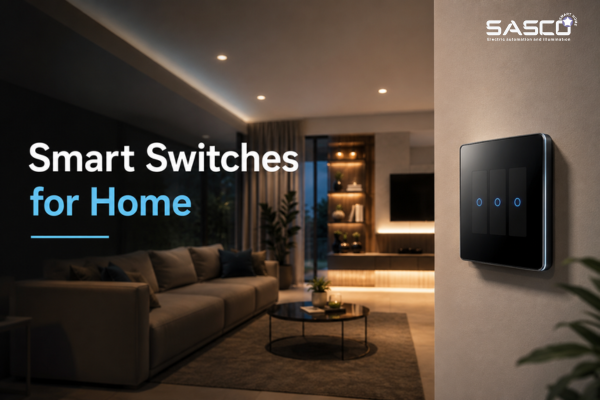
The light switch has been the same object for a hundred years. It’s a physical toggle on a wall — you walk to it, you flip it. For most of that time, there was no alternative. Now there is. Smart switches for home are replacing conventional switches with connected devices that respond to touch, mobile apps, scheduling, and voice commands — all without requiring any change to the existing wiring behind the wall.
The shift matters because it brings intelligent lighting control, connected home devices, and smart living solutions into a home without a full rewire or a renovation. Smart home technology, in this form, is one of the most accessible upgrades available — and for households thinking about automated home systems or energy-efficient homes, it’s usually the right place to start.
SASCO Smart Homes installs smart switches and broader home automation solutions across Delhi NCR, handling everything from product selection through to integration with existing systems.
What Are Smart Switches?
A smart switch replaces the conventional wall switch in the same location and wiring. The difference is what it connects to.
Instead of a purely mechanical toggle, a smart switch contains a small circuit that communicates over Wi-Fi, Zigbee, or Z-Wave. This allows it to receive commands from a mobile app, a voice assistant, or an automation hub — in addition to being operated manually like any standard switch.
The installation uses the existing switch box and no new cabling in most cases. The switch connects to its load — lights, fans, appliances — the same way the original did. The change is only in the control interface.
Benefits of Smart Switches for Home
Convenience is the first and most obvious benefit. Turning off lights in a room you’ve already left, controlling a fan from bed, switching off every light in the house before sleeping — these become one-tap actions — the kind of convenience and comfort that feels trivial until you don’t have it.
Energy-saving automation is the benefit most people underestimate until it shows up on the electricity bill. Smart switches can be programmed with schedules: lights turn off automatically at 11pm, fans stop running when no one’s home, appliances don’t run during peak-rate hours. Over months, these small automations accumulate into meaningful savings.
Remote appliance control removes the “did I leave the lights on?” anxiety entirely. Mobile app control means you can check and manage your home’s switches from anywhere with a network connection.
Voice assistant integration means hands-free control through Alexa, Google Assistant, or Siri. Useful in the kitchen, while working — truly hands-free control without reaching for your phone.
Seamless device integration with other smart home components — sensors, cameras, thermostats — allows smart switches to become part of larger automation routines rather than standalone devices.
Types of Smart Switches
WiFi Smart Switches — connect directly to your home router. No additional hub required. The easiest to set up and the most common entry point for new smart home users. SASCO installs these for homeowners who want a simple, standalone upgrade without committing to a full ecosystem.
Zigbee and Z-Wave switches — communicate over dedicated radio protocols rather than Wi-Fi. More reliable in large homes where Wi-Fi coverage can be inconsistent. Require a compatible hub or controller but offer better performance across a multi-switch setup.
Voice Controlled Smart Switches — any smart switch with voice assistant integration functions as a voice controlled smart switch. This is less a category than a feature — most modern WiFi smart switches support Alexa and Google Assistant natively.
Touch and gesture switches — capacitive touch panels rather than physical toggles. Common in premium residential projects where the aesthetics of the switch matter as much as its function. Available in backlit and frameless versions that suit modern interior design.
Scene controller switches — a single panel that triggers predefined scenes rather than controlling a single load. Press one button and the living room lights dim, the fan slows, and the TV turns on. These sit at the top of the range for smart lighting automation.
How Smart Switches Fit into Home Automation
Smart switches in home automation are often the entry point into a wider ecosystem. Once you have connected switches in place, extending the system becomes straightforward.
A motion sensor can trigger a smart switch to turn on a corridor light when someone approaches — and turn it off automatically after they pass. A smart switch controlling the bedroom fan can be included in a “goodnight” routine that locks the doors, dims the main lights, activates home security automation, and sets the AC temperature. This is what smart home ecosystem integration looks like in practice — IoT-enabled devices communicating with each other based on rules you define once.
Wireless home automation built on smart switches is also scalable. Start with two or three switches in the most-used rooms. Add more as needed. The system grows with the household’s requirements without requiring infrastructure changes at each step.
Key Features to Look For
Compatibility with your voice assistant — if you use Alexa, Google Home, or Apple HomeKit, confirm the switch supports that platform natively.
Load type — different switches are rated for different loads. A switch designed for a light circuit may not handle a heavy motor load safely. Check the rated wattage and load type before buying.
Neutral wire requirement — many smart switches require a neutral wire in the switch box. Older Indian homes often don’t have one. Some newer smart switches are designed to work without neutral — confirm this before purchase if it applies to your home.
Mobile app quality — the app is the primary control interface for most users. Look for one that’s stable, receives regular updates, and allows proper scheduling and group control.
Physical override — the switch should work as a standard manual switch even when the network is down. A smart switch that stops working without Wi-Fi is a usability problem.
Are Smart Switches Worth Installing?
For homes where lighting and appliance control is a daily friction point, yes. The convenience benefit alone justifies the upgrade for most households. The energy-saving automation adds a secondary financial argument that compounds over time.
The case for smart switches in home automation is stronger when they’re part of a broader plan — where they integrate with other devices rather than sitting in isolation. Installed thoughtfully, they change how a home operates in ways that become quickly invisible because they work reliably and without attention.
For a consultation on smart switches or integrating them with an existing automation setup, visit sascosmarthome.com or write to projects@sascosmarthome.com.
Conclusion
Smart switches for home are one of the most practical upgrades available because they solve a real daily friction without requiring significant infrastructure change. Connected switches, voice controlled smart switches, and scene controllers all bring different levels of functionality — the right choice depends on how much integration you want and how you use your home.
Start with the switches you interact with most. The rest follows from there.
Smart switches are connected wall switches that let you control lights and appliances through apps, schedules, or voice commands.
Most smart switches can still be operated manually even if the Wi-Fi connection is unavailable.
Yes, they usually fit into existing switch boxes and can often be installed without major wiring changes.
Yes, scheduling and automation features help reduce unnecessary power consumption and improve energy efficiency.
Most voice controlled smart switches are compatible with Alexa, Google Assistant, and selected Apple HomeKit devices.