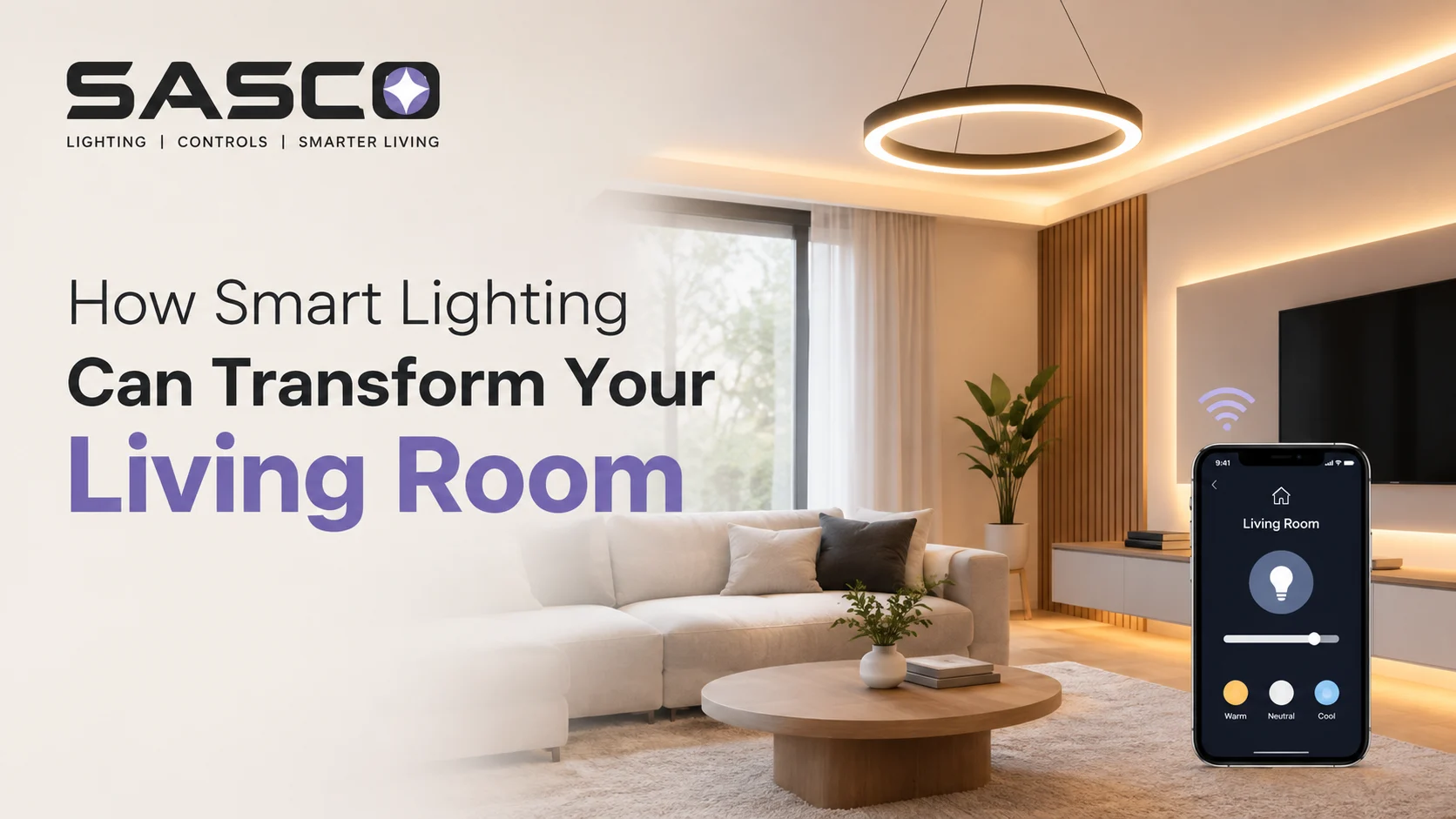
Smart lighting for living room spaces does something a fixed ceiling fixture never can — it changes with how you’re actually using the room. The same living room that needs bright, even light for a family afternoon looks completely different at 8 PM when you’re watching a film or hosting friends for dinner. With a conventional switch, you get one version of the room. With smart lighting, you get all of them.
LED smart lighting for home is now well beyond novelty. The combination of tunable colour temperature, scene control, dimming, and voice or app operation has made smart home lighting a practical upgrade rather than a technology experiment. SASCO Smart Homes designs and installs complete home automation lighting systems — KNX, ABB, Control4 — for residential projects where the brief is “lighting that responds to life rather than requiring life to adapt to lighting.” This guide covers how smart lighting for living room spaces actually works, what you can do with it, and why the installation is simpler than most homeowners expect.
Create Different Moods With Smart Lighting
The most immediate benefit of smart lighting for living room use is control over atmosphere. A living room doesn’t have one mood — it has several, depending on the time of day and what’s happening in it.
Morning and afternoon — bright, neutral to cool white light (3500K–4000K) that keeps the room energised and accurate for reading, conversation, and day-to-day activity.
Evening relaxation — warm white (2700K–3000K) dimmed to 30–50% of full brightness. The shift in colour temperature and intensity signals the body that the day is winding down, which affects comfort and melatonin production.
Television mode — ambient at low intensity, warm white bias lighting behind the screen. This reduces the contrast between the bright display and dark surroundings that causes eye strain over long viewing sessions.
Entertaining — a scene that emphasises feature walls, art, and architectural details while keeping conversation areas pleasantly illuminated without overhead harshness.
All of these are possible with one button tap or a voice command. No manual dimmer adjustment, no switching between lamps.
Smart Living Room Lighting Ideas
Cove lighting on a smart circuit — indirect LED strip in a ceiling reveal, dimmable and tunable. When warm and low, this is the most relaxing ambient option in any living room. When bright and neutral, it provides clean, shadow-free general illumination.
Accent track lighting with scene presets — directional smart lights on an adjustable track, programmed to highlight specific wall art or architectural features. The direction stays fixed; the brightness and colour temperature adjust with the scene.
Smart floor and table lamps — plug-in smart LED bulbs or dedicated smart lamp fixtures that integrate into the room’s scene control. These handle the task lighting layer — beside the sofa, near a reading chair — at independently controllable intensity.
Colour-capable LED strips — for feature walls or behind media units. RGBW smart strips allow the living room to shift colour entirely for specific occasions, themes, or preferences.
Create Smart Lighting Scenes
A scene is a saved state for multiple fixtures simultaneously — specific brightness levels, colour temperatures, and which lights are active, recalled with a single command. Smart living room lighting ideas become most useful when built into scenes rather than controlled fixture by fixture.
Morning — cove at 80% neutral white, track lights active, floor lamps off.
Movie — all overhead lights off, warm amber bias light behind the TV at 10%, floor lamp at 5%.
Evening — cove at 40% warm white, track lights at 20% warm, floor lamp at 30%.
Party — cove at 60%, accent lights highlighting art and features, colour strips active.
Scenes can be triggered by time of day (automated), by voice command, by a wall panel button, or by a single tap in the SASCO Smart Homes app. Once configured, the lighting adapts to the room’s function without any manual adjustment.
Check out the – Architectural Lighting: Types, Applications, & Benefits
Smart Lighting for Home Decor
Smart lights for home decor go beyond practical lighting — they change how the room’s visual elements read. The same piece of art looks different under warm accent light versus cool white ambient. The same sofa reads differently against a dimly lit background versus a well-lit one.
Good home automation lighting design uses smart control to shift emphasis within the room at different times. In the afternoon, the windows and natural light are the visual anchor. In the evening, artificial lighting takes over — and where it directs attention shapes the room’s character. Art, plants, textured walls, and architectural features become part of the interior lighting design rather than background elements.
The other decor benefit is fixture reduction. When one smart track system handles accent, ambient, and scene-shifted atmospheres, you need fewer physical fixtures cluttering the ceiling or occupying floor space.
How Smart Home Lighting Works
Smart home lighting consists of three layers: the light source (LED), the controller (smart driver or smart bulb), and the interface (app, voice assistant, wall switch, or automation schedule).
The light source — LED lighting ideas in smart applications use the same efficient LED technology as standard lights. The difference is that the LED driver or bulb includes a wireless communication chip (Zigbee, Z-Wave, KNX, Wi-Fi) that allows it to receive commands from the control system.
The controller — either a smart bulb (for retrofit applications) or a smart driver/switch behind the wall (for hardwired systems). In SASCO’s KNX and ABB installations, the controllers sit in a panel and manage multiple circuits with professional-grade precision.
The interface — the app, a voice assistant (Google Home or Amazon Alexa), a wall panel, or automated schedules. In practice, scenes are set up once and then triggered by the most convenient interface for each moment.
Smart Lighting Installation: Do You Need to Renovate?
Not necessarily. The answer depends on how the home is wired and what level of integration is required.
Retrofit (no renovation) — smart bulbs in existing fittings, smart switches replacing existing wall switches, smart plug-in lamps. This works in almost any home without any electrical work beyond the switch replacement. Limited integration capability but practical for most rooms.
Full home automation integration (planned or existing conduit) — KNX, ABB, or similar professional-grade systems require proper wiring runs. In new construction or major renovation, this is planned from the start. In existing buildings, SASCO assesses the conduit and wiring infrastructure to determine what’s feasible without major disruption.
For most homeowners considering smart lighting installation in an existing home, a hybrid approach — smart switches and smart bulbs for the living room, integrated more fully when the home is next renovated — is the practical entry point.
Benefits of a Smart Lighting System
Energy savings — smart home devices including lighting switches off automatically when rooms are empty, dims when full brightness isn’t needed, and uses occupancy-adjusted schedules. LED lighting at 50% brightness uses approximately 50% of full-load energy.
One-touch scenes — the practical convenience of getting the right lighting without manual adjustment is underestimated until you have it. One button for movie mode, one for entertaining, one for morning routine.
Voice and remote control — useful for anyone who can’t easily reach a switch, or for adjusting lighting from the sofa rather than walking to the wall.
Integration with the rest of the smart home — smart lighting for living room control integrates with blinds, HVAC, AV systems, and security. “Good night” mode can dim lights, lower blinds, lower temperature, and arm the system simultaneously.
Conclusion
Smart lighting for living room spaces changes the relationship between the room and the people in it. Instead of adapting activity to whatever the fixed light provides, the lighting adapts to the activity — automatically, on schedule, or on command.
SASCO Smart Homes designs and installs smart lighting systems from basic app-controlled switches to full KNX home automation integration. For a consultation on what’s right for your living room and home, visit sascosmarthome.com.
FAQs
1. What is smart lighting for a living room?
Smart lighting for living room spaces uses connected LED lights, smart switches, and controls to adjust brightness, colour temperature, and lighting scenes.
2. What are the best smart living room lighting ideas?
Popular smart living room lighting ideas include cove lighting, accent track lights, smart floor lamps, table lamps, and colour-capable LED strips.
3. Can smart home lighting be installed without renovation?
Yes, smart home lighting can often be added without renovation using smart bulbs, switches, plug-in lamps, and wireless controls.
4. How does a smart lighting system work?
A smart lighting system combines LED fixtures with smart controllers and an app, voice assistant, wall panel, or automated schedule for control.
5. Can smart lighting reduce energy consumption?
Yes, smart lighting can reduce energy use through LED technology, dimming, automated schedules, and occupancy-based controls that switch lights off when unnecessary.