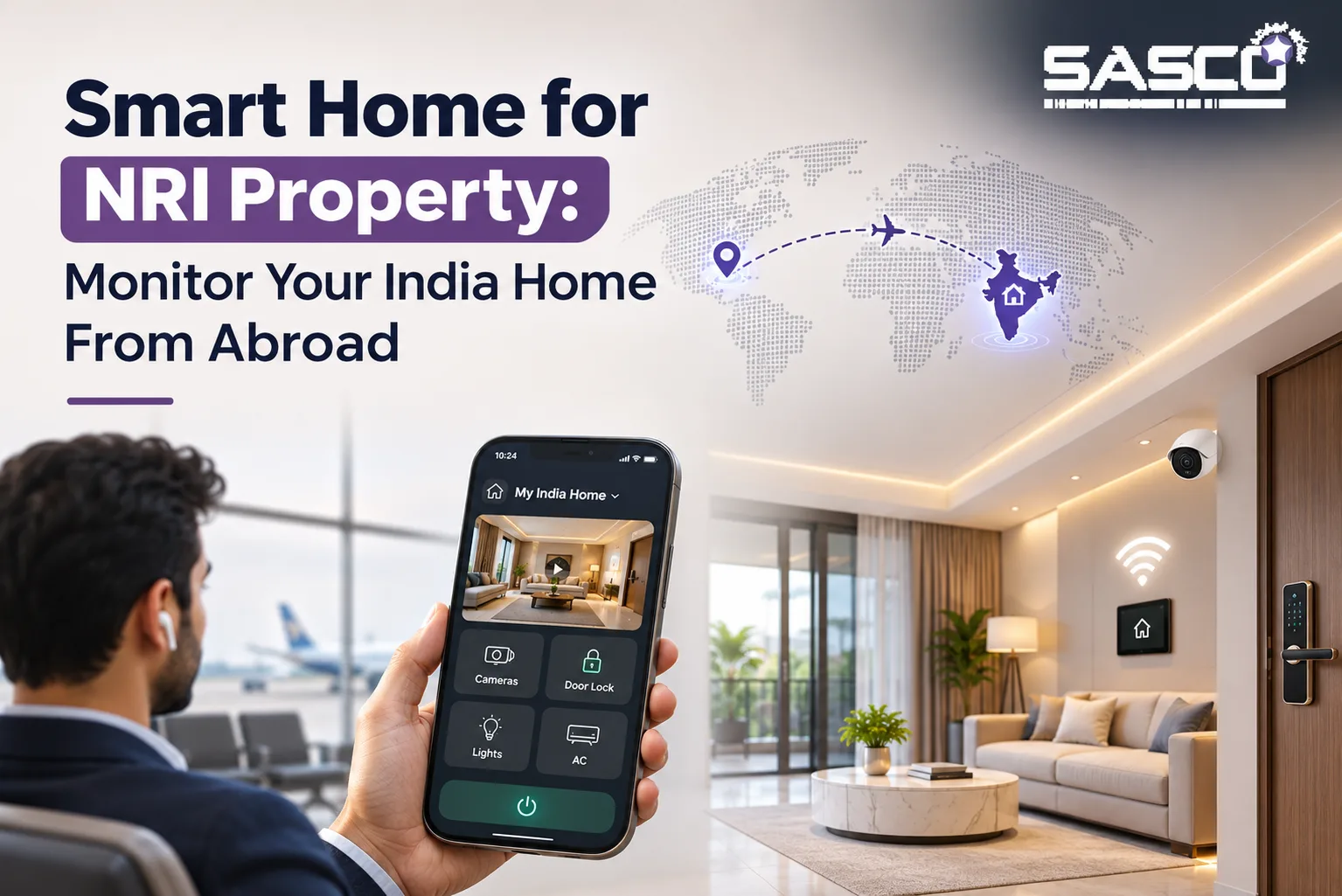
The phone call usually comes at the wrong time. A neighbour says there’s water coming out from under your door, or the caretaker mentions the gate lock is broken, or the tenant has moved out and nobody noticed the geyser was left on. When you live in Dubai, Toronto or Sydney and the property is in Delhi, Pune or Hyderabad, a small problem has two weeks to grow before anyone with authority sees it.
A smart home for NRI property fixes the visibility gap. CCTV remote viewing shows you the entrance, a smart lock with remote access lets you control who gets in, a water leak sensor warns you before the damage spreads, and power failure alerts tell you the house has gone dark. SASCO Smart Homes designs and installs complete home automation systems using professional platforms such as KNX, ABB and Control4, and the same systems that run a family home can be set up to be watched and managed from another country. This guide covers what to install, how to manage it and what keeps it working when you aren’t there.
Smart Home Devices for Remote Home Monitoring in India
Remote home monitoring India setups work best when a few core devices cover the risks that cause the most expensive damage.
| Device | What It Does | Why NRIs Need It |
| CCTV with remote viewing | Live and recorded video on your phone | See the entrance, parking and interiors |
| Smart lock with remote access | Unlock, lock and issue temporary codes | Control entry without couriering keys |
| Water leak sensor | Alerts on leaks, with optional auto shut-off | Burst pipes and tank overflow cause major damage |
| Power failure alerts | Notifies on outages and restored supply | Spot a dead house before food and equipment spoil |
| Remote AC and geyser control | Switch on or off from the app | Cool the house before arrival, shut off what was left on |
| Gate automation | Open the gate for staff or deliveries | Manage access without being there |
You don’t need everything on day one. A leak sensor, a smart lock and CCTV cover most of the real risk. Add the rest as the system proves itself.
How to Manage Your Indian Property From Abroad
Most of the day-to-day work happens through cloud app control. One app shows camera feeds, lock status, sensor alerts and device switches, and you can check them at any hour, whatever the time difference.
Give your caretaker limited access. Caretaker access codes can be set for specific days and hours, then changed or deleted from your phone. There’s no need to hand over a permanent key or share a master code.
Use schedules instead of memory. Lights on at dusk and off at a set hour make an empty house look occupied. Water pumps and geysers can run on a timer rather than depending on someone remembering.
Prepare the house before you land. Remote AC and geyser control means the house is cool and the water hot when you arrive from a long flight, instead of waiting a few hours after landing.
Set it up for tenants. Tenant-ready automation keeps the owner in charge of the important controls such as door lock codes, cameras in common areas and main switches, while letting the tenant control lights and comfort. When a tenant leaves, you reset the codes in minutes.
Ask for a monthly home health report. Some installers can summarise device status, battery levels, alerts and outages once a month, so small faults get fixed before they turn into failures. Confirm this with your provider at the design stage rather than assuming it’s included.
How Smart Home Automation Improves NRI Home Security
NRI home security is mostly about early warning, because you can’t respond physically.
Know who entered and when. A smart lock records every entry with a time and code. If the caretaker came on a day they shouldn’t have, you see it.
See, don’t guess. When a motion alert fires, CCTV remote viewing shows whether it was a cat, a delivery or a problem. That saves unnecessary panic calls to neighbours.
Catch damage early. A water leak sensor connected to an alert or a shut-off valve limits flooding. Power failure alerts tell you when to ask someone to check the fridge, the sump pump or the aquarium.
Make an empty house look lived in. Scheduled lights and occasional curtain movement discourage opportunistic break-ins.
Control access to the building. Gate automation lets you let in a plumber or a delivery person after verifying them on camera, instead of leaving the gate to the guard’s judgment.
None of this replaces a trusted local contact. It gives that person better information and gives you a record.
What Makes Remote Home Monitoring Work Reliably?
A smart home for NRI property is only useful if it’s reachable when something happens. Most failures aren’t about the devices. They’re about power and internet.
Backup power. Put the router, camera recorder and smart hub on a UPS or inverter. Without power, nothing reports.
Backup internet. A second connection, such as a 4G failover, keeps the house online when the main broadband goes down. This matters when the property is empty for months.
Local control. Good systems run schedules and safety logic on a local controller, so core automations continue even if the internet drops. Cloud access then reconnects when the line returns.
Alert routing. Alerts should reach two people, you and a local contact, through push notifications or messages. A single phone that’s switched off defeats the purpose.
Regular maintenance. Camera lenses get dusty, batteries run down and Wi-Fi settings change. A periodic check, ideally part of a service contract, catches these quietly.
How to Choose a Smart Home Solution for Your NRI Property
Choose professional, not consumer-only. For a smart home for NRI property that has to work unattended for months, platforms such as KNX and Control4 are built for reliability in a way that a mixed set of cheap plug-in devices often isn’t.
Ask for remote support. Your installer should be able to diagnose problems remotely and have a local team to visit when needed.
Plan for the property type. A flat needs a lock, cameras, leak sensors and a hub. A villa adds gate automation, outdoor cameras and perimeter lighting.
Keep it simple for the caretaker. If the system needs training to use, it won’t get used. Give local staff only the controls they need.
Check who owns the access. You, not the installer, should hold the admin accounts. Confirm this before handover.
Start with the biggest risks. Entry, water and power cover most of what goes wrong in an empty house. Everything else can follow.
SASCO Smart Homes designs these systems around how the house is actually used, starting with a consultation before any product is chosen.
Conclusion
Owning a home in India while living abroad doesn’t have to mean worrying about it. A smart home for NRI property gives you eyes on the entrance, control over who comes in, early warning on water and power problems, and a way to prepare the house before you arrive. Reliable remote home monitoring India depends as much on backup power and internet as on the devices, so plan those from the start.
For NRI home security and home automation designed for long-distance ownership, visit sascosmarthome.com to discuss your property.
FAQs
1. What is a smart home for NRI property?
A smart home for NRI property uses connected devices like CCTV, smart locks, and sensors to monitor and manage a home remotely.
2. How can NRIs monitor their property in India from abroad?
NRIs can use mobile apps to view CCTV feeds, check smart lock status, control appliances, and receive water leak or power failure alerts.
3. Which smart home devices are best for remote home monitoring in India?
CCTV cameras, smart locks, water leak sensors, power failure alerts, and remote AC controls are useful for monitoring an unattended property.
4. How does smart home automation improve NRI home security?
It helps track property access, verify visitors through cameras, manage entry remotely, and receive alerts about suspicious activity or potential damage.
5. How can I ensure reliable remote home monitoring when I’m abroad?
Use backup power for essential devices, arrange backup internet, enable alerts for a local contact, and schedule regular system maintenance.